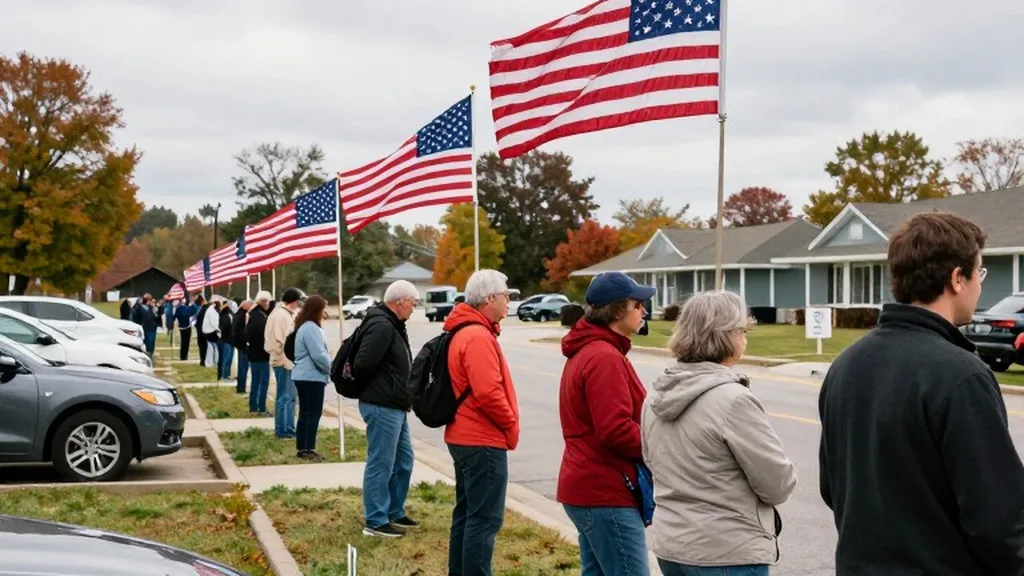
Senate Showdown: 35 Seats, 13 Battlegrounds, and the Math for Control
With 35 seats at stake, Democrats need four net gains while Republicans can afford to lose only two, making 13 competitive races the focus of the day's voting.
By Tunde Bailey ·
The United States is in the midst of a decisive midterm election that will determine which party controls Congress for the remainder of President Donald Trump's second term. Of the 100 seats in the U.S. Senate, 35 are up for election on November 3, 2026. This number includes 33 regular elections and two special elections to fill the terms left by Marco Rubio in Florida and JD Vance in Ohio. The current composition of the Senate sees Republicans holding 53 seats and Democrats holding 45, with two independents who caucus with the Democrats. This margin leaves the balance of power precarious, as the math for control is tight for both parties.
For Democrats to secure a majority in the upper chamber, they must achieve a net gain of four seats from their current standing. Republicans, conversely, can afford to lose only two seats to maintain their control. This arithmetic makes the 13 identified battleground races critical to the outcome. These races are spread across states with varying historical voting patterns and current political dynamics. The stakes are high because the Senate's majority determines legislative agendas and confirmation powers for the final two years of the current administration.
The battleground map includes a mix of incumbent defenses and open seats. In Alaska, Republican Sen. Dan Sullivan is defending his seat in a state where Donald Trump won by 13.1 points in 2024. In Florida, the special election features Republican Ashley Moody, also in a state with a 13.1 point margin for Trump. Georgia presents a closer contest with Democratic Sen. Jon Ossoff facing Republican Rep. Mike Collins in a state that Trump won by 2.2 points in the previous presidential cycle. Iowa is an open seat following the retirement of Republican Joni Ernst, a state that Trump won by 13.2 points.
Other key races include Kansas, where Republican Roger Marshall is running in a state Trump won by 16.2 points, and Maine, where Republican Susan Collins faces Democratic Troy Jackson in a state where Kamala Harris won by 6.9 points. Michigan is another open seat after the retirement of Democrat Gary Peters, with the state having voted for Trump by a narrow 1.4 points in 2024. Montana is an open seat following the retirement of Republican Steve Daines, a state Trump won by 19.9 points. Nebraska features Republican Pete Ricketts in a state Trump won by 20.3 points.
New Hampshire is an open seat following the retirement of Democrat Jeanne Shaheen, with the state having voted for Harris by 2.8 points. North Carolina is an open seat after the retirement of Republican Thom Tillis, in a state Trump won by 3.3 points. The special election in Ohio features Republican Jon Husted, a state Trump won by 11.2 points. Texas involves the seat held by John Cornyn, with the state having voted for Trump by 13.6 points. These races are closely watched because small shifts in voter turnout or preference could tip the balance of the chamber.
Political analysts and media outlets have rated these races using various methodologies. As of October 27, Maine is considered a toss-up by Cook, Decision Desk, Inside Elections, and Sabato. Iowa is rated as a toss-up or leaning Republican. Kansas is viewed as a toss-up to lean Republican. Alaska is seen as a toss-up to lean Democratic. Michigan is rated as a toss-up to lean Democratic. Georgia is considered a lean to likely Democratic race. These ratings reflect the uncertainty in states where the margin of victory in the 2024 presidential election was narrow or where local dynamics have shifted significantly.
The Associated Press describes the election as a referendum on Trump's second term, noting that voters are struggling with high prices and are angry over an unpopular war with Iran. Polling from AP-NORC indicates that 35 percent of U.S. Adults approve of Trump's job performance, while 25 percent approve of his handling of the economy. About seven in 10 adults say the country is heading in the wrong direction. These economic concerns are driving voter behavior in many of the 13 battleground states. Candidates are focusing their campaigns on cost of living, healthcare, and the direction of the country.
Republican National Committee Chairman Joe Gruters emphasized the importance of turnout, stating that if Republicans turn out their voters, they will win. Democratic Congressional Campaign Committee Chair Rep. Suzan DelBene countered that the American people are angry and want change. These statements highlight the differing strategies of the two parties as they mobilize their bases. In North Carolina, former Gov. Roy Cooper is facing Michael Whatley, while in Ohio, Sherrod Brown is challenging Jon Husted. In Michigan, Abdul El-Sayed is running against Mike Rogers, with recent endorsements adding to the competitive nature of the race.
In Texas, Ken Paxton is competing against James Talarico, with Trump having backed Paxton over John Cornyn in the primary. In Maine, Susan Collins is facing Troy Jackson, with the AP noting that economic strain and tariffs have made the state more competitive. In New Hampshire, Chris Pappas is running against John E. Sununu. In Kansas, the race has become central to the fight for Senate control despite the state's reliable Republican history. In Alaska, the Trump administration filed a lawsuit related to the certification of the Senate result, adding a layer of legal complexity to the race.