Brazil's Final Push Before Election
Rival leaders hold massive rallies as voters prepare to decide the nation's future in a tight contest.
By Petra Murphy ·
With the national election scheduled for Sunday, the political landscape in Brazil has reached a fever pitch. On Saturday, the two leading presidential candidates held separate rallies to mobilize their bases, marking the end of a grueling campaign season characterized by intense debate and shifting public sentiment.
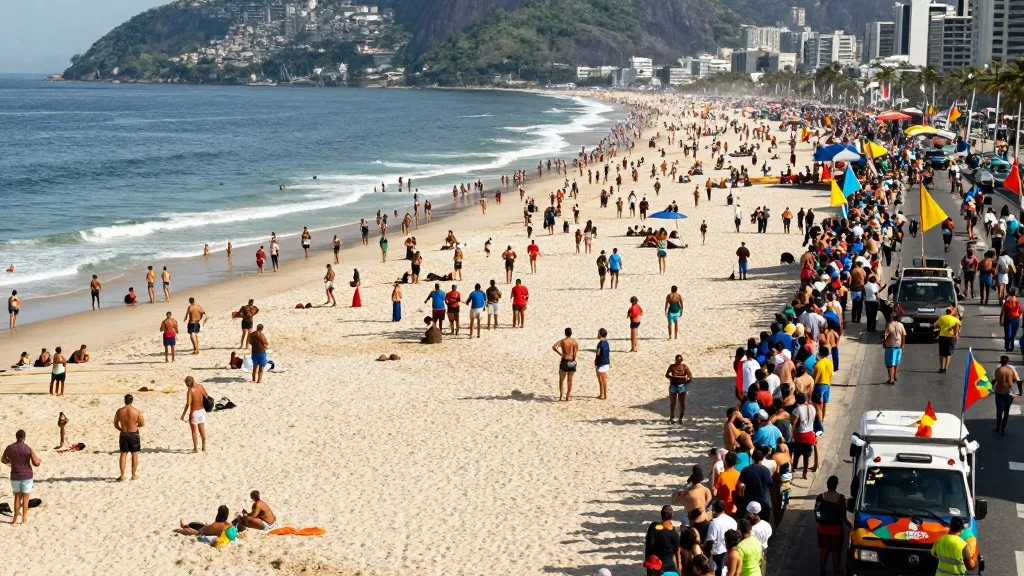
In Rio de Janeiro, incumbent Luiz Inacio Lula da Silva addressed a large crowd at Copacabana Beach. Dressed in a red hat, the 80-year-old leader stood on a campaign truck, waving a Brazilian flag to the hundreds of supporters gathered below. He focused his message on the relationship between Brazil and the United States, specifically referencing his rival's ties to American President Donald Trump. Lula stated, "The people must choose either someone who kisses the national flag or someone who kisses the American flag."
This contest represents a pivotal moment for the region, as it will determine whether Brazil maintains its current left-wing leadership or aligns with a broader rightward shift seen in other parts of the world. Lula is seeking a fourth term, which would be non-consecutive, while his opponent, Flavio Bolsonaro, aims to restore his family's political influence. Flavio, a sitting senator and the son of former President Jair Bolsonaro, entered the run-off with a narrow lead in the first round, securing 47 percent of the vote compared to Lula's 45 percent.
Recent polling data indicates that the race remains extremely close. A CNT/MDA survey released on Saturday showed Bolsonaro at 46.3 percent and Lula at 45 percent. This is consistent with a week earlier, when the same poll had Bolsonaro leading 46.8 to 45.9. The margin of error for these surveys is 2.2 percentage points, suggesting that either candidate could win with a shift of just a few voters.
Supporters of Flavio Bolsonaro held their own significant event in the southeastern state of Minas Gerais. The gathering featured hundreds of motorcyclists wearing the yellow national football shirts, creating a vibrant display of support. One attendee, Ebert Dorigo, spoke to AFP about the need for change. He argued that the Workers' Party, Lula's political group, had fostered a reliance on government welfare. Dorigo stated, "The values we uphold are nation and family," adding that the country is divided because some citizens believe improvement comes only through hard work, not state assistance.
The campaign has highlighted deep societal divisions, particularly regarding economic policy, crime, and the direction of the state. Bolsonaro has proposed adding hundreds of thousands of new prison places to combat crime and reducing overall government spending. His father, Jair Bolsonaro, who served as president from 2019 to 2022, is currently serving a 27-year prison sentence. He was convicted of attempting a coup after his defeat in the 2022 election.
Despite the intensity of the ground game, the final debate on Friday saw a slightly calmer tone between the two leaders. They still exchanged accusations regarding Brazil's economic challenges and their respective records, but the verbal sparring was less heated than in previous rounds.
For many undecided voters, the choice is difficult and often feels less than ideal. Gabriela Ribeiro Viana, an event organizer, expressed this sentiment to AFP. She noted, "If there were any other candidate, that would be a better option. But we're stuck choosing between the worst, the horrible, and the lesser evil." This sentiment reflects a common feeling among citizens who feel forced to pick the least problematic option in a polarized field.
As the campaigning concludes, the focus shifts entirely to the ballot boxes. The outcome on Sunday will not only decide who leads Brazil but will also signal the country's stance on its relationship with the global economic order and its internal social contracts.
More Politics · World news · Report a business · Got a Story?