Eckerd Scholars Debate Religious and Political Boundaries
Guest speakers from Northwestern and Washington University in St. Louis explored how faith and statecraft intersect in modern American society.
By Alina Carter ·
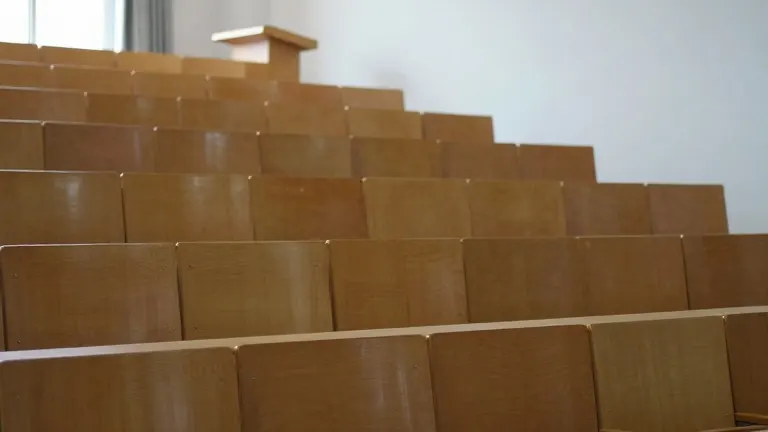
Religious ideas permeate American political life in ways that often remain invisible to the general public. On the Eckerd College campus in St. Petersburg, Florida, two academic experts recently convened to examine this specific overlap.
The event, organized by McCrary, brought together Elizabeth Shakman Hurd and Tazeen Ali. Hurd holds a doctorate and serves as a professor of political science and religious studies at Northwestern University. Ali is an assistant professor of religion and politics at Washington University in St. Louis.
The panel was moderated by Robert Galloway, the chaplain and director of the Center for Spiritual Life at Eckerd. Galloway and audience members directed questions to the speakers, who first outlined their respective areas of research.
Hurd focused on the relationship between national security and religious belief. Her book, "Heaven Has a Wall: Religion, Borders, and the Global United States," analyzes borders as both political and religious objects. She argued that Americans often treat security as a sacred concept that sits above the law.
"Like both politics and religion, national security draws you into something bigger," Hurd said. "You're compelled to participate." She cited the work of Kathryn Lofton to explain that religion can be a force that ensnares individuals rather than just a group they join.
Ali presented research on how television constructs images of Islam and gender. Her current book project, tentatively titled "Muslims on Screen: Racism and Sexuality in Anglo-American Islam," examines this dynamic. She pointed to recent political events to frame her argument, specifically the response from Michigan Democratic Senate candidate Abdul El-Sayed.
When asked to disavow the Muslim Brotherhood, El-Sayed stated, "I'm not running to be a Muslim senator. I'm running for U.S. Senate and happen to be Muslim." Ali suggested this response reveals the changing position of Muslims in American public life and electoral politics.
Students in the audience engaged with the material through different academic lenses. Lexi Davis, a junior from Mountain View, California, majoring in religious studies and humanities, began reevaluating the category of religion itself. Jasmine Fernald, a junior anthropology major from New Carlisle, Indiana, reflected on the deep intertwining of faith and government. "We like to say that religion and government are separate, but they are so intertwined," Fernald said.