Blue Origin pushes New Glenn back to January as Artemis II hits atmosphere
NASA and Amazon wait for the rocket's return while three brothers test water-powered propulsion for deep space travel.
By Tunde Bailey ·
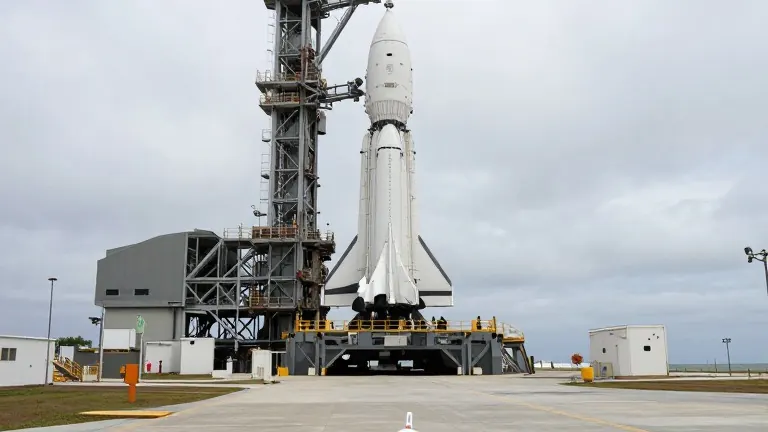
The launch pad at Cape Canaveral, Florida, is still a construction site. Nearly six months after a catastrophic explosion wrecked the structure, workers continue rebuilding the facility that Blue Origin uses for its New Glenn rocket. The company announced a delay to the New Glenn return-to-flight mission on Thursday. The flight, originally scheduled for December, will now launch in January. This shift gives engineers more time to finalize repairs and prepare the vehicle for its next attempt.
Blue Origin released several technical updates during a press event that same afternoon. The company unveiled a new kick stage design for the New Glenn rocket. It also introduced a new rocket engine configuration. These hardware changes aim to improve performance for future missions. The delay aligns with the reconstruction timeline for the launch complex. NASA, Amazon, and the Space Force all have pending payloads on the New Glenn manifest. Their demand for launch capacity has grown as the program recovers from its setback.
In a separate development, three former SpaceX engineers are testing a different approach to space propulsion. The Carlisle brothers founded Argo Space in late 2022. They previously worked on the Falcon 9 program. Their company builds satellites that use water as a primary resource. Instead of carrying separate tanks of liquid hydrogen and liquid oxygen from Earth, Argo Space spacecraft carry a reservoir of liquid water. In orbit, solar power splits the water into hydrogen and oxygen gases. The system then burns these gases to generate thrust.
Water serves multiple functions in their design. It acts as the propellant, the coolant, and a radiation shield for the spacecraft. This approach could reduce the amount of fuel that must be launched from Earth. The brothers view this as a step toward sustainable space infrastructure. Argo Space flew its first mission in July. The spacecraft failed shortly after launch because one solar array did not deploy. The failure prevented a full test of the propulsion system during that window.
The company has two more missions scheduled for 2027. These flights will focus specifically on demonstrating the water-based thrusters. The next steps for New Glenn involve completing the pad reconstruction and meeting the new January launch date. For Argo Space, the priority is getting the propulsion system operational in its next two attempts. Both companies are moving forward with their respective technical goals despite recent challenges.