Three days: The new UK emergency supply target
Ministers urge households to stock food and water to withstand state-sponsored threats and climate shocks.
By Tunde Bailey ·
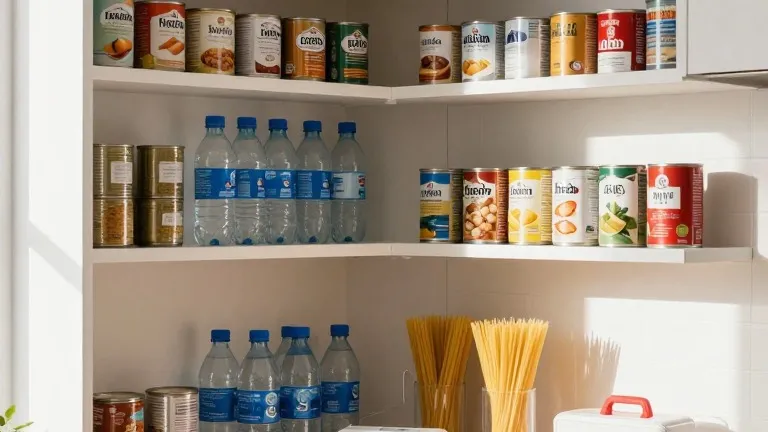
The UK government launched a national campaign on Thursday requiring households to maintain three days of emergency supplies.
Officials cite rising risks from Russian state-sponsored terrorism and the climate crisis as primary drivers for the new directive. The guidance asks residents to store enough food, water, and medical supplies to survive a week-long disruption without external aid. This target aligns with warnings issued by ministers over the past several months regarding potential infrastructure failures.
Households across the country are adjusting their purchasing habits to meet the new standard. Lawrence Barratt in Hythe, Hampshire, began stockpiling items roughly two weeks ago after reviewing the government's Be Ready campaign materials. He now purchases beans, soups, chilli con carne, noodles, and rice alongside bottled water for his family of two. Barratt also acquired a first aid kit, a battery-powered FM radio, a torch, and a portable power bank. He believes the power bank can charge phones, run a television, and power a small fan heater if the grid fails.
Marco Camurri in Greenwich, London, started preparing a few months ago following reports of supply chain disruptions linked to El Niño. His family is gathering pasta, passata, stock cubes, tinned food, bottled water, medicines, and toilet paper. Camurri noted that they keep their car fuel tanks above 50 percent, ensuring approximately 300 miles of driving range. The household also maintains charged power banks, USB rechargeable flashlights, matches, lighters, and wood for a barbecue to boil water if necessary. They are currently tracking expiry dates on a spreadsheet to rotate their inventory, a process Camurri described as resembling one extra week of normal shopping.
Jack Davenport in North Shields pointed to a combination of climate disasters, Russian shadow threats, and energy insecurity as reasons to prepare. He described the country's physical and technological infrastructure as creaking and outdated. Davenport suggested the government aims to reduce long-term panic by framing these threats as probable rather than certain. He noted that several generations have not experienced the hardship that was common before the war.
Not all residents view the new guidelines favorably. Deirdre O'Sullivan in Leicester called the advice daft, comparing it to 1970s instructions to hide under a table during a nuclear attack. She argued that the guidance is inadequate for a genuine emergency, stating that any danger to drinking water should be anticipated more precisely. O'Sullivan contended that an extreme food shortage would become apparent over a much longer period, making the three-day target seem less practical for sustained crises. She likened the policy to a measure a character in Yes Minister would propose to demonstrate that a policy exists, even if that policy is clearly totally useless.