Georgia Camera Logs Halley Dust
An astrophotographer in Toccoa recorded three distinct debris trails from the comet that last visited Earth in 1986.
By Alina Carter ·
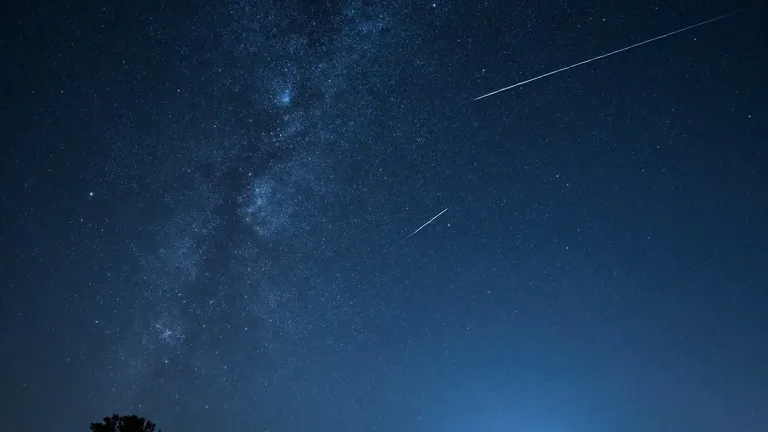
Three bright streaks cut across the darkness above Toccoa, Georgia, in the early hours of Oct. 21. These were not random cosmic events but direct remnants of Comet 1P/Halley. The comet itself sits more than 3 billion miles away, yet its lingering debris continues to burn up in Earth's atmosphere, creating the annual Orionid meteor shower. This specific capture documents the tail of that distant visitor long after the comet has moved on.
Tim McCollum, the astrophotographer behind the image, captured the activity between 3 a.m. and 4 a.m. He used a Canon EOS Ra camera paired with an RF 28-70 f2.0 lens. To ensure the meteors appeared as sharp lines rather than blurs, he utilized a star tracker to keep the equipment locked on the radiant point. This point, where the meteors appear to originate, lies near the red giant star Betelgeuse in the constellation Orion.
The process required patience and precise technical execution. McCollum took multiple 30-second exposures over the course of the night. He later merged these individual frames into a single composite image using PixInsight software. The resulting photograph shows each meteor racing away from the radiant, a geometric signature that confirms their origin within the Orionid stream.
The frame contains more than just the meteor trails. On the right side, the three stars of Orion's Belt are visible, situated close to the glow of the Orion Nebula. This nebula is one of the nearest major star-forming regions to Earth. Further into the dense starfield, the Rosette Nebula, known as Caldwell 49, can be identified. The Milky Way's galactic plane runs diagonally through the background, hosting numerous star clusters amidst the dust lanes.
The display is not yet over for ground-based observers. The Orionid shower remains active until Nov. 7, offering additional nights for skywatchers to spot debris from Halley's Comet. There is also a secondary opportunity in the coming days. Earth is currently passing through debris streams from Comet 2P/Encke. This activity produces the Taurid meteor shower, which occasionally yields bright fireballs around Halloween.